
A faucet that keeps dripping after you turn it off needs attention. Sometimes the problem is a replaceable seal, cartridge, or aerator. Other times corrosion, hard-water buildup, damaged connections, or an aging fixture make professional faucet repair or replacement the more practical choice.
For Tucson homeowners, ignoring the drip can mean more than listening to an annoying sound. EPA WaterSense estimates that a faucet dripping once per second can waste more than 3,000 gallons of water in a year.
The best next step depends on where the water is coming from and what condition the faucet is in.
Why Does a Faucet Keep Dripping After It Is Turned Off?
A faucet can drip when an internal component no longer creates a complete seal. Different faucet designs use different parts, so the exact cause requires inspection rather than guessing from the drip alone.
Common possibilities include:
- Worn washers or gaskets
- A failing cartridge or valve component
- Damaged O-rings or seals
- Mineral buildup around internal parts or the aerator
- Corrosion inside the faucet
- Loose or deteriorated connections
- Water-pressure problems that place additional stress on components
Tucson’s mineral-heavy water can also contribute to scale buildup around faucets and plumbing components. That does not mean every dripping faucet is caused by hard water, but visible white or crusty deposits can be useful information to share with your plumber.
Cool Willy’s provides professional faucet repair and replacement for kitchen and bathroom fixtures throughout the Tucson area.
Is a Dripping Faucet Really Worth Repairing?
Yes. A faucet that continues to leak is worth addressing even if the amount of water looks small.
A steady drip can waste water over time, and the condition causing it may gradually worsen. Water leaking from somewhere other than the spout can also reach cabinets, countertops, walls, or flooring.
Pay particular attention if you notice:
- Water collecting beneath the sink
- Dampness around supply-line connections
- Water around the base of the faucet
- A handle that will not shut the water off completely
- Increasing corrosion or mineral deposits
- A drip that is getting faster
- A sudden change in water pressure
Those symptoms do not tell you exactly which component has failed, but they are good reasons to have the faucet evaluated instead of simply living with the leak.
What Can You Safely Check Before Calling for Faucet Repair?
You do not need to dismantle the faucet to provide useful information to a plumber.
Start with a few basic observations.
Confirm where the water is coming from
Dry the faucet and the area beneath the sink, then watch for new moisture. Is the faucet dripping from the spout, leaking around the handle, or leaving water under the cabinet?
That distinction can help narrow down where an inspection should begin.
Look beneath the sink
Check visible supply connections for moisture without disconnecting or tightening anything. If there is an active leak and you know how to operate the fixture shutoff valve safely, shutting off the affected water supply can help limit damage.
Do not force a valve that is stuck or badly corroded.
Check the aerator if flow is poor
Mineral buildup at the end of the faucet can affect the stream. If the aerator is designed for homeowner removal and the manufacturer provides instructions, cleaning it may correct a minor flow issue.
A dripping faucet that continues when the handle is off, however, usually involves more than the aerator.
When Should You Call a Plumber for a Leaky Faucet?
Call a plumber when the leak persists, involves connections beneath the sink, or comes with symptoms that suggest the problem extends beyond a simple removable aerator.
Professional evaluation is particularly useful when:
- The faucet continues dripping after basic cleaning
- Water is leaking beneath the sink
- The fixture is visibly corroded
- The handle is loose, stiff, or difficult to shut off
- Hot and cold water control has become inconsistent
- Water pressure has changed without an obvious explanation
- Previous repairs have not stopped the leak
- You are unsure how to isolate the water safely
A plumber can identify the faucet design, inspect the fixture and connections, and determine whether replacing an internal component is practical.
Should You Repair or Replace a Dripping Faucet?
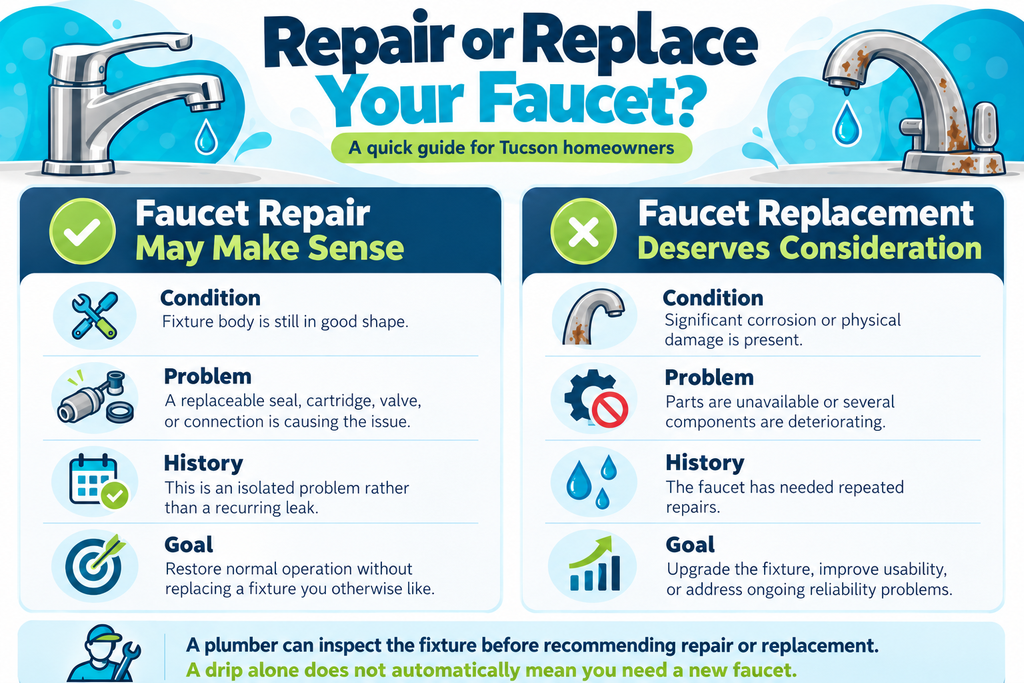
A repair may make sense when the fixture is otherwise in good condition and the failed component can be replaced reliably. Replacement deserves consideration when the faucet has widespread corrosion, repeated problems, unavailable parts, or damage to the fixture body itself.
There is no universal age at which a faucet automatically needs replacement.
Does Tucson’s Hard Water Affect Faucets?
It can. Mineral-heavy water can leave deposits around aerators, valves, cartridges, and visible faucet surfaces.
Over time, scale can restrict flow or interfere with moving parts. However, mineral buildup is only one possible contributor to a faucet problem. Worn seals, damaged components, excessive pressure, or deteriorated plumbing connections can cause similar symptoms.
If you repeatedly find heavy scale on fixtures throughout the house, broader plumbing maintenance or water-quality evaluation may be worthwhile.
What Affects the Cost of Faucet Repair?
The cost depends on what the inspection finds rather than the fact that the faucet is dripping.
Factors can include:
- Faucet type and design
- The component that needs repair
- Parts availability
- Accessibility beneath the sink
- Condition of shutoff valves and supply connections
- Corrosion or mineral buildup
- Whether the fixture can be repaired reliably
- Whether replacement is more practical
If replacement is recommended, the new faucet itself, installation requirements, and any plumbing modifications can also affect the project.
Ask what is included before approving the work so you understand whether the estimate covers repair, replacement, related connections, or additional plumbing concerns.
Can a Small Faucet Leak Turn Into a Bigger Plumbing Problem?
It can, depending on where the leak is occurring.
A drip from the spout primarily wastes water, while a leak beneath the sink can affect cabinets and nearby materials. A deteriorating connection may also worsen unexpectedly.
The safest approach is to pay attention to changes rather than waiting for a minor leak to become an active water-damage problem.
Cool Willy’s also offers broader plumbing repair services if an inspection finds that the issue extends beyond the faucet itself.
FAQs
Can hard water cause a faucet to drip?
Mineral buildup can interfere with faucet components and contribute to performance problems, but it is not the only possible cause. Worn seals, cartridges, valves, corrosion, and water-pressure issues can also contribute to leaks.
Is it okay to leave a faucet dripping for a few weeks?
A persistent drip should be addressed rather than ignored. Even a slow leak wastes water, and a changing or worsening leak may indicate deteriorating components.
Why does my faucet leak from the base instead of the spout?
Water around the faucet base can involve seals, internal components, or connections. Because water can travel before becoming visible, an inspection is the best way to identify the actual source.
Does low faucet pressure mean the faucet needs replacement?
Not necessarily. An aerator clogged with mineral deposits may restrict flow, but pressure problems can also originate elsewhere in the plumbing system. The cause should be identified before replacing the fixture.
Can a plumber install a faucet I already purchased?
Many plumbers can install homeowner-selected fixtures, but compatibility matters. Confirm the faucet fits the sink configuration and discuss the fixture with the plumber when scheduling.
Stop the Drip Before It Becomes a Bigger Problem
If a kitchen or bathroom faucet will not stop dripping, Cool Willy’s Air & Plumbing can help determine whether repair or replacement makes sense. Call 520-595-4132 to discuss your faucet problem or schedule plumbing service in the Tucson area.