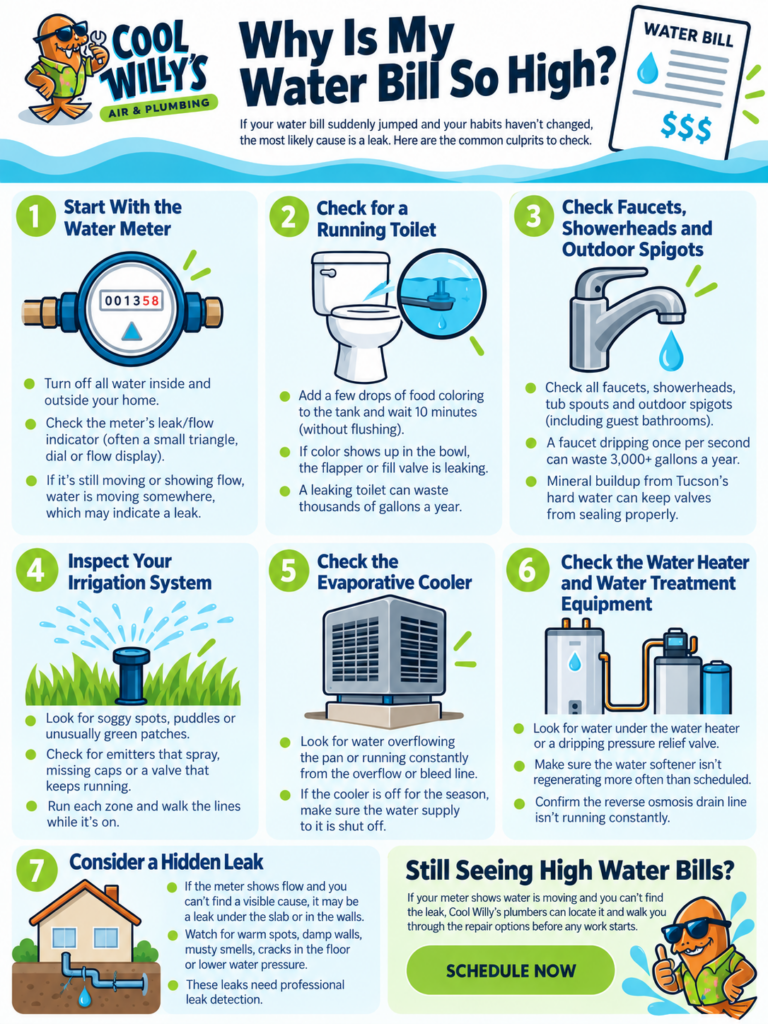
If you’re asking why your water bill is so high and your habits haven’t changed, the most likely cause is a leak. The usual suspects are a running toilet, a dripping fixture, an irrigation line, an evaporative cooler or a water treatment system stuck in a cycle. Most of these you can check yourself in under an hour, starting at the water meter.
Why Did My Water Bill Suddenly Go Up?
A sudden jump usually comes from one of two things: more water use than you realized, or water escaping somewhere you can’t see. Start by ruling out the obvious. Did you have guests, fill or top off a pool, run the evaporative cooler hard through a hot month, or change your irrigation schedule? Summer bills in Tucson naturally run higher than winter ones.
If nothing like that explains it, treat the bill as a leak signal. EPA WaterSense estimates the average household’s leaks waste more than 9,300 gallons a year, and it notes that fixing easily corrected leaks can cut a water bill by about 10 percent.

1. Start With the Water Meter Test
The water meter is the fastest way to confirm whether water is moving when it shouldn’t be. Turn off every faucet and appliance that uses water, including the ice maker, irrigation, evaporative cooler and softener. Then look at the meter.
- Many meters have a small red or black triangle or dial, the leak indicator. If it’s spinning with everything off, water is flowing somewhere.
- For a slower leak, write down the reading, wait two hours without using any water, and read it again. EPA says any change at all suggests a leak.[8]
- To narrow it down, close the main shutoff valve to the house and watch the meter again. If it keeps moving, the leak is likely between the meter and the house. If it stops, the leak is inside.
Tucson Water cannot locate leaks on private property, but it will run a High Bill Investigation on request to check the meter and look for continuous flow.[7]
2. Is a Running Toilet Raising My Water Bill?
Very often, yes. A worn flapper can let water trickle from the tank into the bowl around the clock, sometimes without a sound. EPA notes that an old flapper can silently leak thousands of gallons a year.
To check, put a few drops of food coloring in the tank and wait about 15 minutes without flushing. If color shows up in the bowl, the flapper or fill valve needs attention. A toilet that refills on its own between flushes (“ghost flushing”) points to the same problem. Flappers are an easy fix for many homeowners, and our toilet repair team can handle worn fill valves, cracked tanks or toilets that keep leaking after a new flapper.
3. Check Faucets, Showerheads and Outdoor Spigots
Small drips add up faster than most people expect. According to EPA WaterSense, a faucet dripping once per second wastes more than 3,000 gallons a year. Walk the house and check every faucet, showerhead, tub spout and hose bib, including the ones in guest bathrooms and the laundry room that nobody watches.
Worn washers, cartridges and O-rings are the usual causes. Tucson’s hard water speeds this up, because mineral scale can keep valve seats from sealing completely.
4. Look at the Irrigation System
In the desert, outdoor watering is often the biggest single water use at a home, so irrigation leaks hit the bill hard. EPA estimates a leak about the thickness of a dime can waste roughly 6,300 gallons a month.
Signs to look for:
- Soggy ground, puddles or unusually green patches along a drip line
- Emitters that spray instead of drip, or missing emitter caps
- A zone valve that keeps running after the cycle ends
- Water at the backflow preventer or valve box
Run each zone manually and walk the lines while it’s on. A controller that was reset after a power outage can also start running extra cycles.
5. Check the Evaporative Cooler
An evaporative cooler uses water by design, but a stuck float valve or a bleed-off line set too high can send far more water down the drain than it should. Tucson Water lists evaporative coolers among the common places leaks hide.[7]
With the cooler running, check whether water is overflowing the pan or running constantly from the overflow or bleed line. If the cooler is off for the season, make sure the water supply to it is actually shut off.
6. Check the Water Heater and Water Treatment Equipment
Water heaters and treatment systems can waste water quietly. Look for:
| Equipment | What to check | Who handles it |
| Tank water heater | Water under the tank, or a drip from the pressure relief valve discharge pipe | Homeowner can look. A dripping relief valve or leaking tank needs a plumber. |
| Water softener | Regenerating more often than scheduled, or water running to the drain nonstop | Homeowner can check settings. Stuck valves need service. |
| Reverse osmosis system | Drain line running constantly after the storage tank is full | Usually a valve or membrane issue for a technician. |
A relief valve that drips is doing a safety job, so don’t cap or plug it. It may be reacting to high pressure or high temperature, or the valve itself may be worn. Our water heater repair technicians can find out which.
7. Could I Have a Hidden Leak Under the Slab or in the Walls?
If the meter shows flow and you’ve ruled out everything you can see, the leak may be hidden. Many homes in the Tucson area are built on concrete slabs, and some water lines run beneath the floor or inside walls. Warning signs include:
- A warm spot on the floor (a possible hot-water line leak)
- The sound of running water when everything is off
- Damp drywall, stained baseboards or a musty smell
- Cracks in the floor, or water pooling outside near the foundation
- Lower water pressure than usual
Don’t open walls or break concrete to hunt for it. Hidden leaks call for professional leak detection and plumbing services, where a plumber uses specialized equipment to find the source before anything is cut open.
When Should You Call a Plumber?
Call a plumber when the meter shows water moving and you can’t find a visible cause, or when the leak involves the water heater, a supply line or anything inside a wall or under the floor. Also call if water is actively damaging floors or cabinets. Close the main shutoff first so damage stops while you wait.
Can You Prevent Surprise Water Bills?
You can reduce the odds considerably. Check the meter a couple of times a year, replace toilet flappers as they wear, and keep an eye on irrigation after storms or power outages. A yearly whole-home plumbing maintenance visit helps too: a plumber checks fixtures, shutoffs, supply lines and the water heater before small drips turn into big bills. Cool Willy’s includes this kind of visit in its membership plans.
Frequently Asked Questions
How much water does a family normally use in a month?
It varies by household size, landscaping and season, but EPA WaterSense suggests a family of four using more than 12,000 gallons in a cooler month like January or February may have a serious leak. Compare your bill to the same month last year to see what’s normal for your home.
Can a leaking toilet really double my water bill?
A badly leaking toilet can add a noticeable amount, especially if the fill valve runs constantly. The dye test takes about 15 minutes and tells you whether the toilet is part of the problem.
Will Tucson Water fix a leak on my property?
No. Tucson Water is responsible up to the meter, and it cannot locate or repair leaks on private property. It can check the meter and look for continuous flow through a High Bill Investigation.
How can I tell if the leak is between the meter and my house?
Close the main shutoff valve at the house and watch the meter’s leak indicator. If it keeps moving with the house shut off, the leak is likely in the service line between the meter and the home, which usually needs a plumber.
Is a slab leak an emergency?
A slab leak isn’t always an emergency, but it shouldn’t wait. Water under a slab can damage flooring and the foundation over time, and a hot-water slab leak also wastes energy. If you see active water damage, shut off the main valve and call a plumber.
Get Help Finding the Leak
If your meter says water is moving and you can’t find where, Cool Willy’s plumbers can locate the leak and walk you through the repair options before any work starts. Contact Cool Willy’s Air & Plumbing to schedule leak detection.